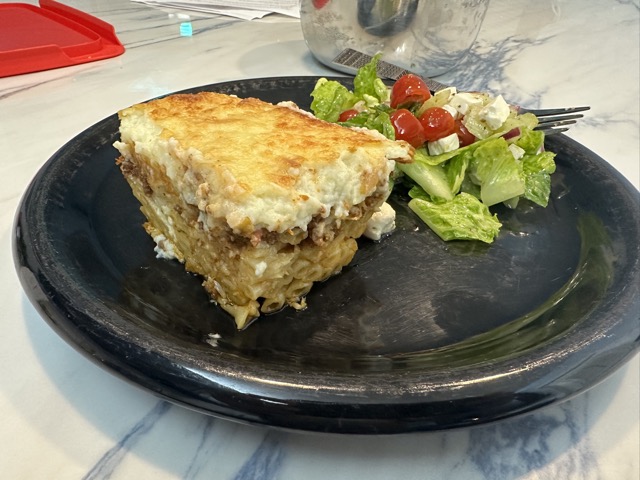
The Greek answer to lasagna — layers of bucatini pasta in a cinnamon-spiced meat sauce, bound together under a golden béchamel crust. Six phases. Thirteen steps. Zero guesswork.
Measure and prepare everything below before you turn on the stove. Group them by phase — when a phase starts, you grab that group and go.
You need 1¼ cups grated Parmesan total. Measure it all at once, then divide: ½ cup for the pasta, ½ cup for the béchamel, ¼ cup for the top.
You need 3 eggs total. Separate 1 egg — the white goes into the pasta, the yolk into the béchamel. Separate 2 more eggs — yolks into the béchamel. You'll have 2 leftover whites (save for another use or discard).
Start the pasta water when the meat sauce has about 10 minutes left. While the pasta boils, start on the béchamel roux. This overlap saves about 20 minutes off the total time. The timeline above is approximate — the checkpoints tell you when each phase is actually done.
Heat 2 Tbsp olive oil in the skillet over medium-high heat. When the oil shimmers and flows easily across the pan (about 90 seconds), add the diced onion. Cook for 4–5 minutes, stirring occasionally, until the onion is translucent and the edges are just starting to turn golden.
Add the minced garlic. Stir constantly for 30 seconds — garlic burns fast. You want it fragrant, not brown. The moment the kitchen smells like garlic, move to the next step.
Add the ground beef. Break it into small pieces with the wooden spoon — you want crumbles, not chunks. Cook for 5–7 minutes until no pink remains. Don't touch it for the first 2 minutes — let it develop a sear on the bottom before breaking it up.
The beef should be uniformly browned with some crispy bits. No pools of liquid — if there's standing moisture, keep cooking. The fat should have rendered and the pan should look dry between the crumbles.
Stir in the tomato paste and cook for 1 minute — it should darken slightly and coat the meat. Add the wine (or broth + vinegar sub). It will sizzle and steam. Scrape the bottom of the pan to release the fond (the brown bits). Let the wine cook off almost completely, about 2 minutes.
Add the crushed tomatoes, cinnamon, cloves, and oregano. Stir to combine. Bring to a simmer, then reduce heat to medium-low. Let it cook uncovered for 15–20 minutes, stirring every 5 minutes.
The sauce must be DRY when it's done. If there's visible liquid pooling when you tilt the pan, keep simmering. Wet sauce will make the pasta layer soggy and the dish will fall apart when you cut it. When you drag a spoon through the sauce, it should leave a trail that holds for 2–3 seconds.
The sauce should smell warmly spiced (cinnamon should be noticeable but not overwhelming), look thick and cohesive, and hold its shape on a spoon. Season with salt and pepper to taste now. Set aside.
Turn heat up to medium-high and stir frequently for 3–5 more minutes. The tomato liquid needs to cook off. This is always fixable — you just need more time.
Set your oven to 375°F (190°C) now. It needs to be fully preheated by the time assembly is done.
Bring the large pot of water to a rolling boil. Salt it generously — it should taste like seawater. Snap the bucatini in half before adding it to the pot. (Dry pasta snaps cleanly; trying to cut it after cooking is messy and uneven.)
Cook the pasta for 2 minutes LESS than the package direction. You're par-boiling — the pasta will finish cooking in the oven. It should be noticeably firm when you bite it, with a visible white core when you snap a piece in half.
Drain well and return to the pot off-heat. Immediately add 2 Tbsp butter and toss until melted and coating every strand. Then add the egg white and toss vigorously — the residual heat will partially cook it into a binding glaze. Finally, fold in ½ cup Parmesan.
Lift a spoonful of pasta — the noodles should cling together rather than fall apart. There should be a visible glossy coating on every strand. This egg-butter-cheese bind is what holds the pasta layer together when you slice the finished dish.
Half-length noodles pack flat and tight into the baking dish, fill the corners, and give you that dense uniform base that slices cleanly. Full-length noodles curl and overlap, leaving air gaps that raise the base height and steal room from the béchamel.
Use room-temperature milk if possible. Cold milk from the fridge drops the roux temperature dramatically, which means the sauce can take 10–15 minutes to thicken instead of 5–7. It will still work — it just takes patience. If your milk is cold and the sauce seems watery after 8 minutes of whisking, don't panic. It's not broken. Keep going.
Melt 4 Tbsp butter in the saucepan over medium heat. Once foaming, add the flour all at once. Whisk constantly for 2 minutes. The roux should smell faintly nutty and turn a very pale gold — not brown. This cooks out the raw flour taste.
Add the milk in three additions, whisking vigorously between each. First addition (~1 cup): the roux will seize into a thick paste — whisk hard until smooth. Second addition (~1 cup): it will loosen into a creamy sauce. Third addition (remaining): whisk until fully incorporated. Continue cooking and whisking over medium heat until the sauce thickens enough to coat the back of a spoon, 5–7 minutes.
Dip a spoon in the béchamel and run your finger across the back. The line should hold without the sauce running back together. If it runs, keep cooking. If it's so thick it mounds on the spoon, add a splash of milk.
REMOVE from heat. This is critical for the next step. In a separate small bowl, beat the 3 egg yolks. Now temper them: ladle about ½ cup of the hot béchamel into the yolks while whisking the yolks constantly. This warms the yolks gradually. Then pour the tempered yolk mixture back into the saucepan, whisking the whole time.
If you dump the yolks directly into the hot sauce, they'll scramble into little curds. The tempering step — warming the yolks first with a small amount of sauce — is not optional. Take the pot off the heat first, temper slowly, and whisk constantly. This is the single most common failure point in béchamel.
Pour the sauce through a fine mesh strainer immediately. You'll lose some volume but salvage the texture. The finished dish won't suffer.
Stir in ½ cup Parmesan and a pinch of nutmeg. Taste for salt. The béchamel should be savory, slightly sweet from the milk, and smooth as silk.
Spray the baking dish with olive oil spray — cover the bottom and all sides. Spread half the pasta mixture evenly across the bottom. Press it down gently with the back of the spoon to eliminate air gaps, especially in the corners. The half-length noodles should lay flat and tight.
Spread ALL the meat sauce over the pasta in an even layer. Then top with the remaining pasta, pressing down again gently.
Pour the béchamel over the top. Use the back of the ladle to spread it evenly to every edge and corner — any exposed pasta will burn. Sprinkle the remaining ¼ cup Parmesan and a pinch of nutmeg over the top.
Looking down at the dish, you should see a smooth, creamy white surface with no pasta poking through. Through the glass sides (if using a glass dish), you should see three distinct layers: pasta, meat, pasta, with béchamel on top.
You can stop here, cover tightly with foil or plastic wrap, and refrigerate for up to 24 hours. Add 10–15 minutes to the bake time if going in cold.
Place the dish on the center rack of the preheated 375°F oven. Place a baking sheet on the rack below to catch any drips. Bake for 40–50 minutes.
The top is deep golden-brown (not pale gold — that's underdone) and the edges are visibly bubbling. The béchamel should look like a golden crust, not a white sauce. If the top is browning unevenly, rotate the dish 180° at the 30-minute mark.
Tent loosely with foil for the remaining bake time. This protects the crust while letting the interior finish cooking.
Remove from the oven and let it rest uncovered for at least 30–45 minutes. This is not optional. The béchamel and egg proteins need to set as the dish cools — if you cut it hot, the layers will run.
This is the hardest step because the kitchen smells incredible and you're hungry. But cutting into a hot pastitsio gives you a sloppy, runny plate. At 30 minutes, the slices hold. At 45, they're perfect. Use a sharp knife and a spatula to lift pieces cleanly.
The first corner piece never comes out cleanly — accept this. It's the cook's snack. Every piece after that will lift out beautifully.
| Method | Duration | Instructions |
|---|---|---|
| Refrigerator | Up to 4 days | Cover tightly with foil or transfer to airtight container. |
| Freezer | Up to 3 months | Wrap individual portions in plastic wrap, then foil. Thaw overnight in fridge before reheating. |
| Reheat (oven) | 20–25 min at 350°F | Cover with foil to prevent the top from burning. Remove foil for last 5 min to re-crisp. |
| Reheat (microwave) | 2–3 min per slice | Works but the crust will soften. Use medium power to heat evenly. |
No-Fail Kitchen — Recipe No. 001
Adapted from MyGreekDish.com with professional refinements and field-tested corrections.